
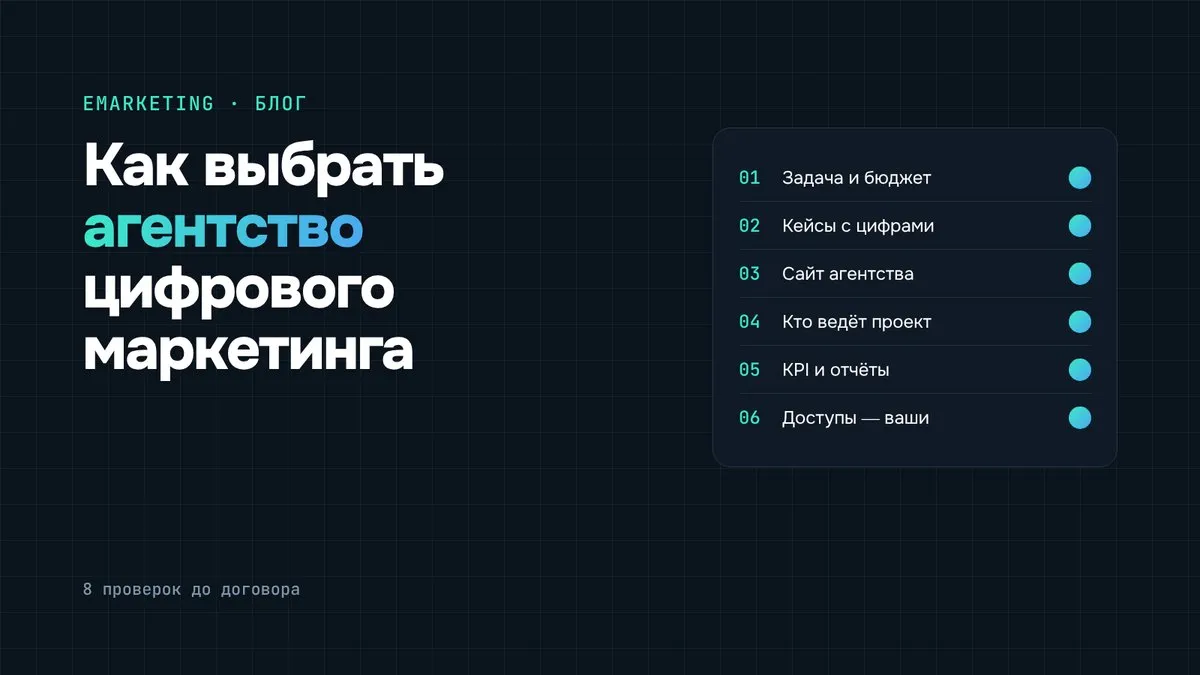
Choosing a digital marketing agency comes down to eight checks: whether you understand your own goal, whether the agency has real case studies, how it markets itself, what KPIs it commits to, who will run your project, who owns the accounts, whether you can start with a small job, and how the contract is set up. Below, we walk through each check and list the questions worth asking at your first meeting.
You give an agency your money and time and expect leads and sales in return. Picking the wrong one is expensive: six months of work, your ad budget and the customers you missed. Yet from the outside, every agency looks the same — polished websites, a “comprehensive approach,” promises to get you “to the top.” The only way to tell a strong partner from a weak one is by specific signs.
1. Define your goal and budget first
Don’t start by searching for an agency. Start by answering one question: what exactly needs to change in your business? More inquiries from your website, more online store sales, awareness for a new brand, a lower cost per customer from ads. That determines which services you need:
- a website — if you don’t have one or it doesn’t bring in customers;
- SEO and GEO — if customers look for your services on Google and ask AI assistants;
- search ads — if you need leads fast;
- analytics — if you can’t tell which channel is working;
- social media — if your product sells through emotion and visuals.
Set a budget too — at least a range. A good agency doesn’t sell “everything at once.” It tells you what to do first with the money you have and what to expect from it. If you ask “what will you do for this amount?” and get a vague answer, that’s your first red flag.
2. Check case studies — with numbers and time frames
A portfolio of nice screenshots says nothing about results. Look for case studies that include:
- the starting point — what things looked like before the work began;
- what was actually done — not “a full range of services”;
- numbers and a time frame — clicks, rankings, leads, cost per lead, before and after, over a clear period;
- the data source — Google Search Console, Google Analytics, the ad account.
It’s fine if the agency doesn’t name its clients — not everyone allows it. But the numbers, the industry and the time frame should be there. Ask to see the data in a live analytics account, even via screen share on a call. And ask about a project that didn’t go to plan: how an agency handles problems tells you more than its three best case studies.
3. See how the agency markets itself
A simple, honest test: search Google for the agency’s main services plus its city. If a company sells SEO but its own site doesn’t show up for a single commercial query, ask yourself why it would do better for you.
Check the rest as well:
- the site loads fast on a phone and makes sense from the first screen;
- there are prices, or at least “starting from” figures;
- real contact details, an address and people are listed;
- the blog and social accounts are active, not abandoned years ago;
- in 2026 — whether ChatGPT, Gemini and Google’s AI answers mention the agency when you ask about marketing agencies in your city.
4. Find out who will run your project
At the first meeting you often talk to an experienced manager or a salesperson, and then a junior does the work. Ask directly: who is accountable for the project, who will actually do the work, and who will you talk to day to day?
A good answer is one person in charge who knows your whole project and speaks the language of business, not jargon. A bad answer is “we have a big team,” with no names or roles.
5. Agree on KPIs tied to revenue
It’s easy to report metrics that grow nicely but don’t bring in money: impressions, reach, followers, rankings for keywords nobody searches for. These are known as “vanity metrics.”
Ask the agency up front which metrics will be in the report and how they connect to your goal. For most businesses, what matters is:
- number of leads — form submissions, calls, messenger messages;
- cost per lead for each channel;
- search traffic to the pages that sell;
- rankings for keywords with real demand;
- for an online store — orders and revenue from each channel.
If the agency suggests setting up analytics and lead tracking in the first month, that’s a good sign. Without it, results can’t be measured — and you can’t hold anyone accountable for them.
6. Make sure you own the website and accounts
A common trap: the website, domain, ad account and analytics are registered to the agency. While you work together, nobody notices. When you decide to leave, it turns out you can’t take your ad history or analytics data with you, and the site “belongs to the contractor.”
The right setup is that the domain, hosting, Google Ads, Google Analytics, Search Console and the site’s admin panel are in your name, and the agency works through access you grant. Discuss this before you start and put it in the contract.
7. Start with a small project
You don’t have to sign a one-year contract right away. Ask the agency to do a small standalone task — for example, an SEO audit of your website or an audit of your ad account.
The result will tell you a lot. Did you get a vague list from an automated checker, or a specific report with priorities — what to fix first, how long it will take and what impact it will have? Were the findings explained in plain language? A pilot project like this costs little but can save you months with the wrong partner.
8. Read the contract and exit terms
Before you sign, check:
- scope of work — what exactly is done each month, not just “website promotion”;
- reporting — how often and in what format;
- timelines — when to expect first results and what counts as a result;
- termination terms — how much notice you need to give to stop the work and what you get when you leave.
Be wary of guarantees like “#1 on Google in a month” or a fixed number of leads. An honest agency can’t guarantee rankings: they depend on competitors and Google’s algorithms. What it can guarantee is transparent work, a clear plan and regular reporting.
Choosing an agency in Moldova
Moldova’s market is small, and that cuts both ways. On the plus side, an agency’s reputation is easy to check through people you know and its former clients. On the downside, many agencies do “a bit of everything” and may lack deep expertise in any one service.
Pay attention to languages. Moldova is bilingual: customers search in both Romanian and Russian, and these are different queries with different competitors. The agency should know how to run two language versions of a website and ad campaigns, not just translate the copy. If you also target Romania or the wider EU, you’ll need English as well.
The numbers back this up. According to Ahrefs (November 2026), the Romanian query “agenție de marketing” (marketing agency) gets about 70 searches a month in Moldova, while the Russian “маркетинговое агентство Кишинёв” gets about 30. “Creare site” (website development) gets 200 searches a month versus 150 for its Russian equivalent. In these niches the Romanian-speaking audience is noticeably larger, and an agency that promotes itself only in Russian misses it — as will your website if it works the same way.
A Moldovan company’s legitimacy is also easy to check. Using the agency’s IDNO (company ID), the public register of the Public Services Agency (Agenția Servicii Publice) shows when the company was registered and who runs it. A Google Maps listing with a Chișinău address and reviews from real clients is another simple signal: an agency that can’t keep its own listing in order is unlikely to do it for your local SEO.
Questions to ask at your first meeting
- What would you do first with our budget, and why?
- Can you show us a case study in a similar industry — with numbers, a time frame and the data source?
- Who exactly will run our project and do the work?
- Which metrics will be in the report, and how often will we get it?
- Whose name will the website, domain, ad account and analytics be registered in?
- When can we expect first results, and how will we know the work is on track?
- Can we start with an audit or a small project?
- How do we stop the work if we’re not satisfied?
If an agency answers these questions specifically and without getting annoyed, you have a good candidate. If you’d like to ask them to us, get in touch — we’ll answer each one and show you where we would start in your case. You can also begin with a free express audit of your website.